
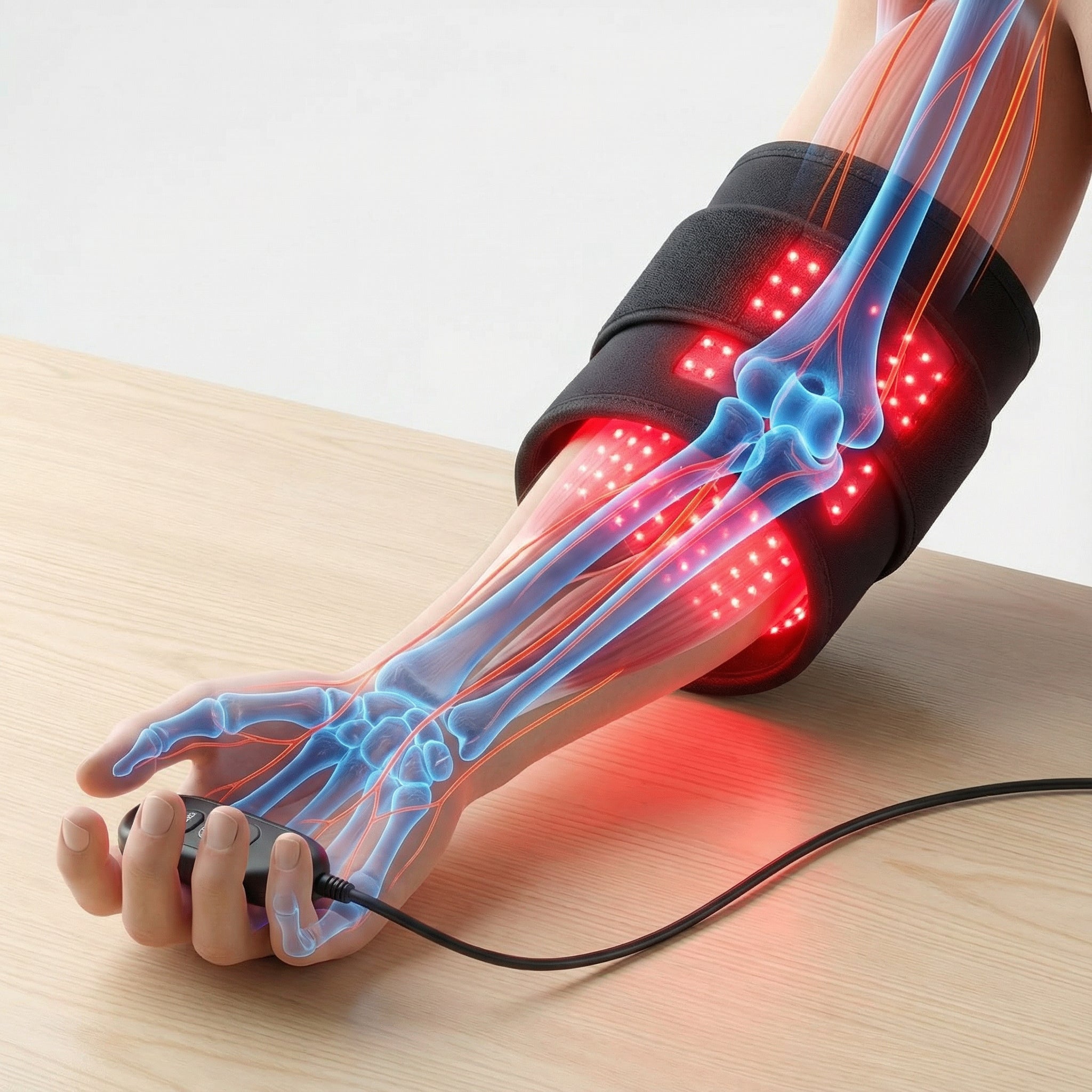
If your elbow hurts — from tennis, golf, pickleball, or just gripping a mouse all day — you've probably seen ads for "red light therapy." But here's the thing: not all light therapy is the same. The color (or wavelength) of light matters a lot more than most product pages tell you.
Let's break down what scientists actually know about red and near-infrared light, in plain English.
So What Is This Light Stuff, Really?
The science-y name for it is photobiomodulation (say that five times fast). All it means is: using red and near-infrared light to interact with your cells.
Here's the simple version of how it works:
- 1. Light hits your skin and travels into your tissue.
- 2. Tiny parts inside your cells — called mitochondria — soak it up.
- 3. This kicks off a chain reaction that boosts your cells' energy and taps into your body's natural repair process.
Think of it like giving your cells a little nudge to work harder.
It's Not Just About Warmth
Here's a common mix-up: people think red light therapy is basically the same as a heating pad. It's not.
Scientists have found that certain light (around 670 nanometers, if you want the exact number) helps blood vessels relax and widen. This is called vasodilation, and it means better blood flow to the area. Studies have even shown this effect can stick around for a while after you turn the light off — not just while you're using it.
The important part: this isn't your skin heating up. It's a chemical reaction happening inside your body. So if a product only talks about "infrared heat," it's actually selling itself short.
Why the Exact Wavelength Matters
Different colors of light reach different depths in your body:
- Blue light stays near the surface — good for skin-level stuff.
- Red light goes a bit deeper — helpful for muscles and skin.
- Near-infrared light goes the deepest — and has the strongest research behind it for reaching joints, tendons, and muscle tissue.
So if you're dealing with tennis elbow, golfer's elbow, or that ache from too much mouse-clicking, near-infrared light is doing the real heavy lifting — not red light on its own. A device using only red LEDs is built for a different job than one designed to reach deeper tissue.
What Does the Research Actually Say?
Scientists have studied red and near-infrared light in things like:
- • Tendon inflammation
- • Tennis and golfer's elbow
- • General joint pain
- • Muscle recovery
That's a solid amount of research on this type of light therapy overall. But — and this is important — that doesn't automatically mean every single product on the market has been tested and proven. If a brand says their exact product is "clinically proven" without showing you a real study on that specific product, it's fair to raise an eyebrow.
The Bottom Line
Red and near-infrared light therapy is based on real science — not just marketing buzzwords. Two things to remember:
- 1. The wavelength decides how deep it goes. For joint or tendon pain, near-infrared light has the better evidence behind it, not red light alone.
- 2. It's more than heat. The real action happens at a chemical level inside your cells, not from simple warmth.
Knowing this stuff makes it way easier to judge any light therapy product you come across, ours included.